Thursday, October 20, 2011

Mulhuddart happenings

I have been really busy with work and travel. Sometimes I get into these phases where I work on one thing day and night because it is very interesting and I want to know how it will turn out. For the last few weeks I have been in this mode; hence no traveling and taking pictures and nothing happening worth mentioning in the blog. Sorry.
There have been weekends where I stay home on Friday and Monday to get work done, and for four days in a row I get up, eat, write code, try to make sense of results, go to bed at two or three, and repeat. No clue whether it's cold or warm outside. I enjoy doing that once in a while and really dig into a problem. I'm learning a bunch of stuff; or at least it feels like it ;-)
But then once in a while that mode of operation needs to be broken. For the last two weekends I promised myself that I would go out and do something, but then I didn't. (I haven't exercised in weeks!) This weekend I will go into town. I have to; I'm running out of Nespresso capsules. Can't work without fuel!


The other day I diverged from my shortest route to work and back, and detoured through "downtown" Mulhuddart to return yet another letter to the previous renters of this apartment. This one looked important: Something from the health department addressed to the parents of the girl who must have lived here. Probably a reminder to have her come in to be vacinated or something.
Across from the post office I noticed a new store had opened that promised international food. Anything international and different from the three chain store brands we have here can only be good. And within walking distance no less!
The couple who opened the store is from Albania and they do have interesting looking things on the shelves. Most of them I have no clue what they are. When they say international, they mean it. The other stores have international food too, but it is all made by Nestle, Kraft, or Dr. Oetker and the labels are still in English. Not in this store. I bought some items that seemed safe and that I would have a chance to actually eat or prepare, like the two items in the picture above, but I need to investigate this some more. It's not just Eastern European either. Lots of Asian stuff as well with the same trend: on many of them not a single word in English or roman alphabet letters.

Sunday, October 2, 2011

Busy

Sunset on Santorini.
Hello everyone, sorry for not posting in the last few weeks. I have been really busy with work and travel. Even though I got to swing through Switzerland on my way to and from Santorini, and even had time for a small hike there, I spent most of my day and night time working on an IPDPS paper. Unfortunately I was too slow to get enough data and explain it appropriately to make the deadline. But we made good progress and have a good paper soon.

Hiking in the Twannbachschlucht in Switzerland.
EuroMPI in Santorini was fun and interesting; the first time attending since I switched jobs. The conference is usually set in some nice European town in September. Fall is a nice time of year because most of the tourists have left, but it is still nice and comfortably warm. It just seems that at many of them I end up spending a lot of time in my hotel working on a paper for the October deadlines.

Conference dinner was in Oia.
I did make a point to be out at sunset every day to get some pictures within walking distance of the hotel. According to Ken Rockwell's advice (a photographer's pages I sometimes read), sunset and sunrise are the only times you need to be out anyway, since that is the only time of day when the light is perfect. I usually can't make sunrises, since I'm in bed. But sunset in Santorini is easy: do that first, then have dinner at 9 with the early dinner crowd.

View from the table at the conference dinner.
I stayed in a cheap hotel that I had booked through the conference registration page. It was fine, but clearly not oriented towards the business traveler. I think they expect people to go out and do things in Santorini, instead of sitting in their room working. The WiFi was free, but didn't really reach my room. My laptop could see the signal, but never log in. So I spent time downstairs in the breakfast area where the base station was. Unfortunately that was accros from the reception desk where the daughter of the owners spent a lot of her time watching TV on her laptop. This was a small hotel with the family of three running most of the operation. I would go back there for vacation, but probably not business.

Evening in Thira, where the conference center was.
I got some good pictures even with the short time I allocated for it. You can see all of them here, but that is easy on Santorini. Aim your camera anywhere and shoot. It's bound to be interesting and capturing.

At a fancier hotel than mine.

People of Santorini make a point to show off their island.

Tuesday, September 6, 2011

Flowers and Sunshine


A while back Lee Ann sent me the plastic flower above. When enough light shines on its little solar panel, it flaps its petals and shakes its head left and right. When I brought it to work my Irish coworkers asked whether my wife didn't know where I was. Patrick took pity on the droopy flower and offered to place it at the window beside his and John's desks. (Mine was further in and got less light.) The little flower was much happier there and joyously moved its petals up and down.
Not that the sun was out that much, so I became suspicious. I accused Patrick of having fertilized it, or hoked it up to the power grid. I even lifted it up to make sure there where no concealed wires. But I guess there was enough light and friendly thoughts after all ;-)
Now I moved to the new building where I'm next to a large window myself. Patrick and John on their way to the cafeteria have come by and waved at it through the window.
The new building is a smart and environmentally conscious building, but it needs some more training. The toilets flush with rain water collected on the roof, but the lights turn off after fifteen minutes; whether you are done or not.
There are automatic shades that should help regulate the inside temperature depending on the cloud level and elevation of the sun. Over our desks are motion and infrared sensors that regulate light levels.
If you move very little, haunched over your keyboard, the infrared sensor is supposed to sense your presence and leave the light on, even if the motion sensor thinks there is nobody there. That doesn't quite work yet and I have to wave my hands at the ceiling once in a while for the light to come back on.
A person falling asleep at their desk might therefore cause the lights to go out. I have been accused of letting that little flower flap its petals and tricking the motion sensor into thinking someone is moving around, while I am fast asleep at my desk.
As you can see, (sun)light is an important topic here in Ireland and even a plastic flower gets a lot of attention and sparks conversations.

Sunday, August 28, 2011

Dublin City Triathlon

I did the Dublin City Triathlon this morning. After having trained so much for the Ironman in July, it felt like a waste not to use that for something else.  After vacation in Switzerland and London, and then not doing anything for another two weeks, I was in no shape to do anything long. But an Olympic-distance triathlon sounded about right.
 About 375 people participated in the event (almost 500 had signed up!?). (There were another 350 people signed up for the shorter sprint-distance event.) We swam 1,500 meters (just under a mile) in the River Liffey, rode bikes in Phoenix park for 40 km (just under 25 miles), and then ran a 10 km (~6 miles) in the park.  At the end we got a nice shirt, free ice cream, and a burger.
 I have only done one race of that distance before: The Elephant Man Triathlon in September 2008.  That was the first race with my then new bike that I still use. The run was the problem though.  I had an Achilles tendon inflammation that was still bothering me at that race and had prevented proper run training. It took me 3:20:51 to finish. For today's race, my goal was to beat the three-hour mark. And I did; by 37 seconds.
I'm happy about that. Here is the comparison:

20082011
Swim 1.5 km  0:31:290:31:52
Transition 10:03:030:04:41
Bike 40 km1:38:271:23:38
Transition 20:01:490:02:49
Run 10 km1:06:050:56:25
    Total3:20:512:59:23

 Of course, it is difficult to compare races like that, even if the distances are the same. The terrain is different, and the conditions, such as weather and altitude, are never the same. But, shaving 20 minutes off my time three years ago does indicate that I have made some progress.
 It's still discouraging though: Almost all the guys in my age group were faster overall.
 I used to chalk this up to them having been athletes all their lives, and me only recently started and 90% of the time that I'm not asleep, I'm sitting at a desk staring at a computer screen. (I have plenty of endurance for that ;-)
Now I'm beginning to rethink this attitude. I always thought of myself as an intermediate swimmer, with about half of the people in the pool swimming a little slower than me, and the other half, or a little more than that, swimming faster. Since I've come to Ireland this does not seem to be true anymore. People here are generally more fit and bike faster than me, walk faster, and also swim faster.
  And it's not only the slender ones that make me look like a snail. There is a group of guys at the National Aquatic Centre where I train, that sometimes swim in the lane next to me. They do 100 m in less than 1:20 on short intervals. On a good day I can do one of those, if that is all I do that day, and I train for it. The scary part is these guys are portly. I wonder what would happen, if they ever cut back on beer...
 The sun took its time to come out this morning. I'm guessing it was below 50 when the race started. That river is cold. Wetsuits were mandatory. I have a sleeveless one because I don't like the restrictive feeling I have in a full suit; this way I can move my arms more freely.  But this morning I was wishing for a full suit. As soon as I jumped in, my feet went numb and I didn't regain any sensation until well into the run. When they came back alive, they tried to tell my brain in a few seconds what had happened to them in the last couple of hours.  And since my brain didn't do anything about it, they kept sending the same signal over and over.
  We went out in waves of about 60 people. In theory that was to make it less chaotic than the 2000-people mass start at a full Ironman. It seemed it was just as bad. Early on I got kicked in the face and my upper lip is still swollen. I was able to draft a few times, but I also seemed to zigzag a lot, despite the organizers having put a floating line in the middle of the river for us to follow upstream, and then downstream on the other side.  It took me about to the halfway point before I found a rhythm and could pass a few people.
 The bike ride was rolling hills in the park. There are a couple of grades to go up, but noting serious. Going up, the wind was blowing into our faces, but it was not horrendous.  The most difficult part was pacing and counting the loops. It was up to us to do five of them and exit the park to get back to the transition area. At the pre-race briefing they said that every year they have a few people who do four or six laps. Once past the park exit, you are not allowed to backtrack to correct your mistake.
 The first part of the run was hard. First I couldn't feel my feet, and then later when I could, they hurt. I stopped at one point to check that my socks had not crumpled up in my shoe and were pinching my toes. Everything was fine; I was just getting weird signals from my feet.
 The last third was good. I still had energy, my feet were back to their normal pain level during running, and I was able to speed up a little. I even passed some people, although they might have been in a later wave, or doing the sprint distance. Most of the course was on grass or going through woods. I'm not really used to that and twice twisted my ankle on the uneven terrain.
 I'm happy with how this race went. I wish I was faster, but given what i can do, I think this one went well and the pacing worked out.
  So, now Mike can leave a comment about how this race report is much longer than the one I wrote for the four-times-as-long Ironman ;-) Maybe report lengths are supposed to be inversely proportional to the race distance.

Thursday, August 25, 2011

Stationary Engines and Pumps


The Blanchardstown shopping center is a small mall not far from where I live. In the first week I was here, I went there a few times to buy things I didn't bring in my suitcases and also to see what Irish stores sell. Eason is an Irish bookstore chain that has a store in Blanchardstown. That's where I found Stantionary Engine Magazine!
This is not a fancy bookstore that specializes in esoteric literature and carries hard-to-find magazines and out-of-print books. It's a typical mall bookstore with bestseller books, a shelf for local authors, candy, travel guides. and the usual stuff you find in these stores. But, they do carry Stationary Engine Magazine ;-)
The grocery store down the hall sells many of the same magazines and newspapers, but not Stationary Engine Magazine. So, Eason is one level up from them. They also sell several photography magazines like American bookstores do and some model railroad and tour bus magazines that I have never seen before. The tour bus magazines are full of pictures of what the next bus looks like that some city has ordered and how many horse powers it has, or descriptions and pictures of luxury tour buses. There are also magazines that do the same thing for tractors and other farm equipment.
I guess it is a little different from Barnes and Noble or Borders. But a Stationary Engine Magazine? Who reads that?
Well, maybe not that many people. Last month when I went to their web site, it was advertising the latest issue, but today the link (above) is dead. Maybe the issue I bought is one of the last ones.
In the introduction it talks about securing those engines. Theft of "sight-feed oilers and magnetos" doesn't seem all that common yet, but some of these engines have appreciated in value over the years and criminal incidents are on the raise! There are letters to the editor, pictures of engines and parts that people are seeking help with to identify, a bunch of ads, and several articles on restoring engines, an events calendar, and a market place.
I'll be checking the link to their web site and the bookstore for new issues. It would be kind of sad if something like that went under.

Sunday, August 21, 2011

Art


One of the nice things about London is that many things are free. For example, we visited the British Museum and the Tate Modern without having to pay. Some special exhibits require a fee, but there is so much to see without paying, that we didn't have enough time event for that.
Another nice thing is that that some of these places let you take photographs. It would be even nicer if you were allowed to bring a tripod, but I was happy to take photos at all. I put my pictures for the British Museum and the Tate Modern up on Picasa.


Museum curators select pieces that are interesting and worthwhile to look at and display them for us to admire. Usually when taking pictures, you have to think what would make a good picture. At a museum that's already taken care of: Everything in there is worthwhile photographing! Then the question becomes what not to photograph. While it is tempting, there is no point in creating another museum catalog.

A replica of the Rosetta stone. They have the original too, but you are not allowed to touch that one.
 Taking pictures reduces to finding objects that are not constantly mobbed by people in your line of sight, things that have enough light on them to not turn out blurry, and items that make interesting subjects (more than all the others) for some reason. Time is also a factor, since our feet hurt after these marathon museum sessions: These places are big.


Now I had to narrow down my selection even further to show you here and on Picasa what I think are worthwhile pictures. For some that got cut out, even for some I included, I wish I could go back and retake from a different angle, or a slightly different camera setting. Although modern image processing software makes the latter almost unnecessary. At least in a controled environment like a museum. Outside is a different story. There might always be better sunlight or cloud formations to go back to a place and improve on the pictures taken last time.

The British Museum with a Utah sky.
I don't usually care too much for modern art, but I thought it would be interesting anyway to go see the Tate Modern. Most of the things in there are junk, but some things are neat and the museum itself offers plenty of opportunity to take pictures.


I know everybody has a different opinion of what art is, and mine is not particularly relevant. I like thinks that are pretty, somehow clever, difficult to make, inventive, cause an emotion (other then blah), or somehow strike me as worthwhile. A piece of art for me is something that has more than one of these qualities.


 I consider most of the things I uploaded into my Tate album to be art. Not everything, though. Feel free to give us your opinion.


Some photography is art too. Which then begs the question, if you take a photo of a piece of art, is the photo art too?

Not sure whether the mirror was part of the piece behind it or not. Is a photo of a mirror showing a piece of art, art? ;-)

How quaint! A photo of a photo from a photographer's collection at the Tate.

Monday, August 15, 2011

A Goodwill Gesture


Remember when Airtricity, my electric company, turned the power off to my apartment? And then two months later they had a solicitor send me a threatening letter to pay the 147 Euros the previous renter owed them. I was very mad.
People advised me to ignore any letter that were addressed to occupier or some such, and did not have my name on it. That doesn't work, though, because they had two accounts pointing to the same apartment: One was mine, and the other was the delinquent one. If nobody responded to their mail, they would turn the power off again: no more blog writing for me!
So, I sent them, and their solicitor, an email followed by a registered postal letter in which I demanded (by return post) a letter of appology, a confirmation that my account was in good standing, stop of all mail to this address that was not intended for me, and 150 Euros in credit to my account for all this harassment and all the hours I lost dealing with them. I said that if they didn't do that, I would hire a solicitor of my own and it would cost them more, if I added that cost to the hours of work I had lost.
I came up with the 150 based on the 147 they wanted me to pay and my (under) estimate of what it would cost to send registered mail. I threw that in to make it more serious. What I really wanted, was for them to straighten out their records and leave me alone.
Nothing happens in Ireland by return post. But, while we were on vacation, I got an email response apologizing for the mixup and a promise of a 150 Euros credit.
Today I got the latest bill, and it shows 150 Euros credit as a good will gesture. This has never happened to me before! Maybe I should go back to school and learn to be a lawyer ;-)

Saturday, August 13, 2011

Signs


In the previous post I listed two of the themes I was pursuing with my picture taking during our vacation. Another theme was signs. I was looking for interesting, nice looking, and colorful signs. The criteria for inclusion in this gallery were lower than the glass and mirror one. Some of these are simple vacation snapshots. The two below are good examples:


They are not exactly master pieces. The left one I took because it seemed such an important place. Is this where they make physics? Do they govern it from here? Who are they? This was just a building along a street we walked. It didn't seem to be associated with any kind of higher institution like a university or maybe the Queen's palace. Can I go there to complain, if I feel gravity is too high?


Others, like the one above, were place we have been or shopped at. Most, however, stood out for one reason or another. They were particularly artistic, or seemed to have hung in place for centuries and were there to announce the location of a business still in operation.


And then there were some that just seemed whimsical. As usual, you can look at all the pictures in this series in my picasa album.


Do you want more or fewer humps?

Friday, August 12, 2011

Bikes, Glass, and Mirrors


I have started processing the pictures from the Switzerland and London portion of our vacation. Processing means mostly straightening some crooked shots, removing dirt and smudges, and selecting those pictures that are worthwhile displaying. I took almost 1,200 during our two-week vacation with the hope that at least 10% are salvageable.
My goal over the last few years has been to increase the percentage of keepers: Spend a little bit more time thinking when taking the picture and save a lot of time weeding through boring pictures and trying to correct those that almost turned out. Today I uploaded 14 and 28. Let me know whether they are worthwhile looking at.
When I was looking for subjects I tried to gather shots for a few themes. The pictures I uploaded today fall into the category of Bicycles and Glass and Mirrors.


A lot of people ride bicycles in Switzerland, but in London it was almost difficult to take a picture without having a bike in the frame. It was obvious that that should be one of my themes, but I didn't realize that until later, so that collection is relatively small. With the rain helping along, some of these could actually be in both albums:


The other thing that was obvious in London was that glass and mirror effects were everywhere. This provided lots of opportunities to catch colors, reflections, and play with focus to create interesting pictures.
What make some of these pictures interesting is that you can look at them for a while and still discover new elements. The one at the top of this post is an example. After looking at it for a while and changing what you are focusing at, you start seeing new things. I think I can see a man in that picture.
Here are a couple more that have multiple levels and it takes a while to figure out what belongs where.


You can view the remaining pictures of these two collections here and here. Now I have to work on the other pictures and hope to find another 78 good ones to reach my 10% goal. I'll let you know when I upload the next batch.

Thursday, August 11, 2011

Barney's Rescue (no, not THAT Barney!)

While doing some reading about the river Liffey here in Dublin I came across this story that's weird, heartwarming, and sad all at the same time.
Last month an 18-year old man grabbed the pet rabbit of homeless John Byrne (38) and threw the helpless animal into the river Liffey. John jumped off the O'Connel bridge and rescued his rabbit named Barney. It took about 40 minutes for John, and the rabbit, to be rescued themselves: The river is quite a bit below street level in that area, and there is no easy way to get back up from it.
The young man who committed the crime was charged with animal cruelty and abusive behavior to the gardai who arrested him. John got offered a job at an animal farm for showing such compassion.
You can read the story here and here. This article has a video of the rescuer being rescued.

When I read this article I didn't know what to think. When I first encountered the story, it wasn't clear where the rabbit had come from. Then, who would do such a thing? Why? Who is that homeless person? Strange, but nice; I think.

News articles in Europe often include the age in parenthesis after the name of the people mentioned in the article. Sometimes a story makes more sense when you know how old the people are participating in it. Not this one, though.
Sometime the river Liffey flows backward, uphill! When the tide in the Irish Sea rises, it pushes the river water back inland.

Sunday, August 7, 2011

Tour of Ireland


After my race, all of us spent a week in Switzerland and then another week in London. Anika and her friend Matthew had more vacation time than us working adults and so had time to visit me in Ireland. They explored Dublin and its surroundings on their own while I had to go back to work, but last weekend I had three days off, rented a car, and we went to a few places further away from Dublin.
I'll post pictures from our vacation soon. In the meantime have a look at the ones I took on our mini vacation here in Ireland. I posted them on picasa.
Even though Ireland is small, it is not possible to see it all in a few days. We selected the Burren, the Dingle peninsula, and the ring of Kerry as our destinations for that weekend.
The weather, always unpredictable and changing, wasn't great and I hope to go back to some of these sites and take pictures in sunlight. We had quite a bit of rain, but also a lucky few moments when we didn't have to use our umbrellas to take in a view or hide in a visitor center.

Living just below the clouds. At sea level!

Sometimes bad weather can make for good photo opportunities.
Driving on the left required concentration but it wasn't hard after a while. Shifting with my left hand was more difficult. Our car had six forward gears and I was never quite sure which one it was in at the time I released the clutch. The hardest part, though, was navigating the narrow roads. Even main roads are often just barely wide enough to let two cars cross each other. Most roads have no shoulder but are lined with hedges on either side. Leaving enough room for oncoming cars means brushing and scraping along those hedges and getting hit by the occasional branch that sticks out. After being accused by Anika of driving too far to the left (and hitting a mirror or two on parked cars) I watched cars in front of me. They were doing the same thing. It seemed better to brush along a hedge than colliding with an oncoming car. Driving here takes a lot of concentration and makes you tired.
The Clifs of Moher are a world-famous attraction but were a little underwhelming in the weather we saw them. In proper sunset light, like on the postcards, or from a boat, these tall walls look much more impressive. We need to go back and have another look.

The Cliffs of Moher
 More of the cliff walk used to be accessible to tourists but had been blocked off for safety reasons. 650-feet falls aren't especially healthy. If you google for Cliffs of Moher accidents and falls, you find plenty of reports. Until a few years ago, people were allowed to go right to the ledge and peek over it. Even looking at these people doing that looks scary. Now, they have fences and try to keep people at a safe distance. As the picture below shows, success is limited and resentment against the restrictions is high. While we were there, people in the safe zone were talking about the people living dangerously and how the gene pool could be improved with a good gust of wind (which happens frequently here). Some parents took their small kids out onto the cliffs which caused even more comments.


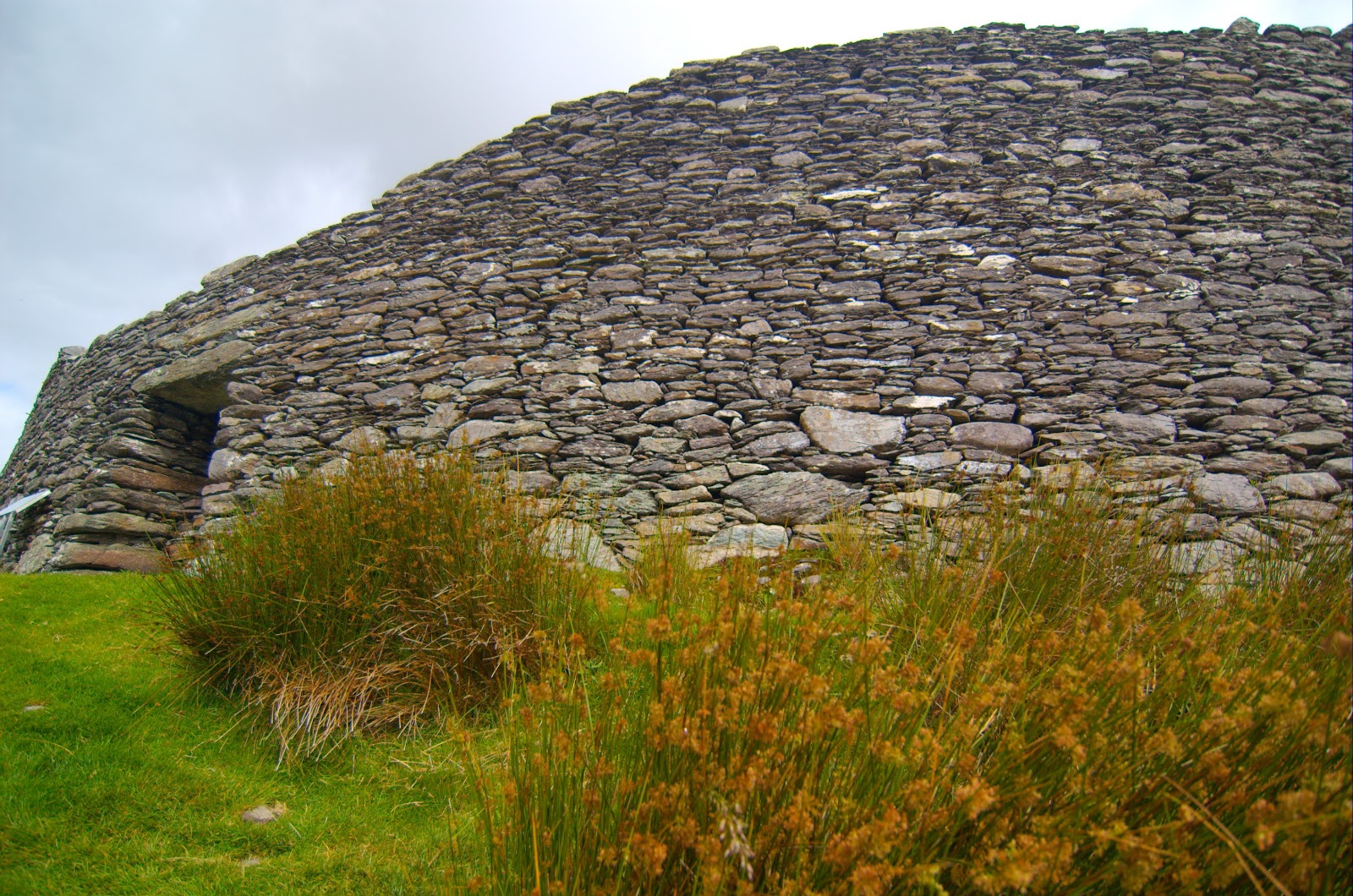
On day two we drove around the Dingle peninsula. The sights were fantastic, but mostly rained out. On the other hand, we learned a lot about the history of this area. Stone ring forts and beehive dwellings from prehistoric times show that people have lived here for thousands of years. The writings from more recent inhabitants show that life here was difficult at times.
Peig Sawers married a farmer on Blasket Island and later told her life story in a Gaelic autobiography. The success of the book ignited a small literary movement and encouraged other inhabitants to write about their struggles and experiences.
This area is close to the western-most point of Europe. The next county to the west is the USA. A lot of the stories written on Blasket Island tell of hardship and famine, and friends and family who have left to settle in the USA. Some of them never heard of again, others in regular contact sending news of hope and loan money for a ship passage to the USA. In the 1950's the Blasket Islands were evacuated. The dwindling number of inhabitants and supply of peat (turf), their heat energy supply, made continued inhabitation too difficult. Today, tourists roam the ruins left behind.


Peig Sayers is buried on the mainland, overlooking the Blasket Islands.
The ring of Kerry is on the larger peninsula just south of the Dingle peninsula. The guide books warned us of hordes of tourists and big tour buses, but we had to negotiate crossing them on the narrow roads only a few times. The weather was also much better on that day, but we had less time, since we had to drive back all the way to Dublin that evening.
An impressive sight are the store ring forts built between 1,700 and 1,500 years ago. Mostly the outer walls remain, and the small entrance gives an indication that defense was an important part of daily life back then.


Another aspect that intrigues me is how religion has shaped the lives of people and is reflected here in monuments, buildings, and the history of this land. It is not uncommon to see a place here that was holy to a group of long-forgotten people, and then find that when Christians arrived, they would build churches on the same sites, putting graveyards on top of older ones, mixing pre-christian symbols with crucifixes. What made the Christians believe that a site for worshiping Norse or Celtic gods was also a site favored by their god?

An ogham stone near Kilmalkedar where the Normans later built this Romanesque church.
 Ogham is an old irish language alphabet that consists of stick marks cut into the edge of rocks or pieces of wood. The stone above is burried deep into the ground from hundreds of years of buildup in that graveyard that has been used by the Celts and Christians alike. The ogham stone had been there about 900 years before the Normans build the church about 800 years ago.
The cross in the picture below has been placed many hundred years ago and suffered the same fate as the ogham stone: Most of it is underground now.

The ground has risen, covering the base of that cross.
Another interesting site of religious significance is Skellig Michael. It is the larger of two islands off the Irish coast, about seven miles from the ring of Kerry. Bad weather and stormy seas make it often unsafe to dock a boat there. In the sixth century, a group of monks decided that it would be an ideal place to live a harsh and isolated life. This close to the edge of the world, they believed themselves closer, and more true, to their god. It is hard to imagine how these people survived there for nearly six hundred years when they finally moved to the mainland nine hundred years ago.

Skellig Michael and Little Skellig.
We did not have time to make the often-canceled-due-to-bad-weather boat trip to Skellig. But I want to come back, climb the steep steps leading up the 700 feet mountain splinter (Gaelic: skellig) sticking out of the ocean, and see the abandoned monastery and oratories. I'll probably never figure out what makes people do weird things in the name of religion, but it is interesting to see the artifacts they leave behind and trying to understand what drove them to such extremes.

A mural in the visitor center for Blasket Island.
The remaining pictures are on picasa. I wish we had more sun to brighten them up a little, but we had a fascinating trip nevertheless.

Thursday, July 28, 2011

Race Report


Anika, her friend Matthew, and I are back in Dublin after spending a little over a week in Switzerland and another in London with Lee Ann and James. We'll go exploring Ireland this three day weekend and at the end of next week Anika and Matthew will head back to the States.
My fears of not finishing the Ironman were unfounded. Despite some problems I had plenty of time and am now the pround owner of a Ironman finisher medal and shirt.
I arrived two days before the event in Switzerland with my saddle, aero bars, helmet, shoes, wetsuit, and all the other stuff to do one of these events. My brother kindly lent me his bike which we outfitted with parts from mine and adjusted for my geometry. I was rushed traveling there and nervous, and promptly forgot the pedals and race tires I had wanted to bring along. I bought new tires and disassembled my brothers shoes to put the cleats that fit his pedals onto my shoes. This all worked fine until about ten minutes into the bike part of the race.


I did well in the swim, finishing in the first 20% of my age group, despite that I took it very easy and mostly let other people drag me through the water. The start was a mess with 2,000 people kicking and pushing each other. It got a little better after a while but about half way through we were funneled through the narrow straight in the picture above and had to run over a small island just to jump back into the water and finish the second loop. I'm happy with my time and the fact that it did not feel like I spent a lot of effort and energy on it.
Transition from swim to bike was slow, but there is no point in worrying about losing a minute or two in a fourteen hour race. Less than ten minutes on the bike and my feet felt funny. It was like they were floating on top of the pedals. After a while I had to stop and investigate. All six screws on both cleats were loose! I thought I had tightened them well enough and they held for two training rides on Friday and Saturday, but now there was a danger of the cleats falling off. About forty minutes ahead was an aid station with a mechanic, so I tried to pedal gingerly to keep constant pressure on the screws and not let them wiggle out and get lost. Fortunately, I did not have to wait that long. A mobile mechanic had stopped to helped a rider fix a flat, and he had a screwdriver I could borrow. In my haste, I fixed the right shoe cleat such that my foot was at a weird angle for the rest of the race. Near the end I was looking forward to the run, so I could put my feet back into parallel again.
I had a very carefully figured out pacing strategy that didn't work, but a failing bike computer helped me overcome that. Initially I had heart rate limits that I did not want to exceed in order to retain enough strength and endurance for the run. My heart rate was much lower than that, and when I went faster to reach those limits, I felt I was overexerting myself for this stage of the race. This worried me a lot, but the bike computer told me that I was going much faster than I had planed. So, I tried to keep a balance between how much exertion I felt and a good speed a little bit above what I had planed; ignoring my HR monitor for the most part.
During the second bike loop I realized that the bike computer would sometimes show zero km per hour and after a while started working again. During the time it showed zero it was not advancing the riding time that I had used to conclude I was going way faster than anticipated. Redoing these calculations using my wristwatch time, I saw that I was slightly ahead of plan, but nowhere near as much as the bike computer had shown.
This, I think, was a good thing. Otherwise I would have tried to bring my heart rate up more, thinking that I needed that to make the bike cut-off. I had a good bike time (for me) and came off the bike feeling like I could easily (slowly) run a marathon. Without the computer malfunction I would probably have stressed more and ruined my pacing.

The last part of the bike was in a heavy thunderstorm with strong head winds.
The second transition was also slow. I was soaking wet from the rain and changing into running gear took a little longer because of that. But that was fine, and soon the rain stopped.
The first loop out of four for the run was fine. It was slow, but I felt I could jog for the rest of the race and achieve my secondary goal of not having to walk during the running portion. Unfortunately, I missed that goal by a long shot.


Half way into the second lap, I bonked and had to start walking. At first I could not understand why, because I had felt good and things were going well. After a while I realized that I had not taken in any food during the first loop; only liquids. I walked to the next aid station and stuffed myself, and then walked some more to let the nutrition do its magic. It sort of worked. After a while I was able to jog again, but it was very hard. Part of it was psychological: once you start walking it is very difficult to convince yourself that running is worth the effort and pain it costs. The other part was probably physiological: it takes a while for food to be processed and be able to use the energy it contains.
Somewhere in there I was following an Italian guy my age or a little older. He was not doing all that well either, but he was faster than me when he was actually running. At one point we go by some park benches and he yells out in joy and plops down on one of them right in front of me. I cursed him, since it tool all my willpower not to sit down right next to him. After a while he passed me again, only to stop at the next aid station to chat with the pretty volunteer there. He did that a few times to me, but now I was one my fourth loop, he had only three arm bands and needed to do another lap, and I was feeling better, knowing that I could finish from here; and soon.
As is usual for me, I kept wondering why I was doing this and reminding myself to remember that I don't actually like pain. As a matter of fact, I hate it. That's why I always have signed up for the next race already, forcing me to continue training. This time I have no race lined up and am ready to retire from the sport (after a five-year, not greatly successful "career" ;-) I'm ready for the couch, some crisps, a beer, and a large-screen TV!


But now my poor run performance is bugging me. This time I was worried about the bike but thought I would do really well on the run for a change. I'm not sure what to do about the bike. I was nearly last in my age group, but I don't think I should have gone much faster without jeopardizing my run. Maybe with more training something under seven hours would be possible and still able to walk afterward. Still not a great time, but better than what I did in Zurich.
On the run, however, I know I can do better. Simply not walking would easily shave of thirty minutes or more. I don't want to do all this training again, but not having done any exercise for three weeks is beginning to bother me, and I think I could do this a little bit faster. Yes, I did an Ironman, which very few people out of the total population have done, but I am one of the slowest in my age group to finish, which so far has never bothered me too much. Breaking into the first half of my age group would be nice, though. I have to think about this. Maybe I'll do another one for my 55th birthday ;-)

Pictures are courtesy of my brother. Thanks!